
It’s time to do the harder things
June 2026

I looked out the car window on my trip to Tahoe, eyeing each house that passed. I admired the red frame that outlined a blue door. The ornate curls that stretched across a Victorian roof. The globe lights strung on an A-frame cabin. In Tahoe, I walked around my friend’s 11k race and stopped to look at the camera stands disguised as tree stumps. The grand bell to be rung at the finish line. The traffic cones neatly strung together with orange ribbon around the trail. I found myself drawn toward crafted, intentional things. The things that told me the creator cared to create something for me.
Then I reflected on the things I regularly consume. The Aritzia sweaters I bought that pilled after a couple wears. The overpriced salad bowl I ate from Sweetgreen. I bought the things everyone saw and talked about. The things that were just easy and cheap enough to produce and just attractive enough that I would exchange my money for it.
But something about these things feel so different from the people I fill my life with. My friend Andrew pictures what it would look like for us to be able to order custom medications for ourselves, how we would trust it, how we would be able to afford it. After watching Andrew work, I feel hopeful that there is a person out there focused on creating a great recovery experience for me. My sister Joyce wants to see more people in loving relationships. I feel inspired seeing her imagine a world where people no longer complain about dating and have the heart and communication skills to deeply connect with each other.
And so in these stark worlds where I’m drowning in heartless, unimaginative things but surrounded by people who choose to believe we can experience better, I want to say:
Let’s all choose to do the harder things.
What are the harder things?
In any industry, there are easier and harder things to create. The harder things are the projects that take greater effort, span longer timelines, and have more unknowns while the easier things take fewer resources, are fast to get out the door, and have been done many times.
Let’s take the TV show industry for example. The History Channel was launched in 1995, showcasing documentaries on WWII, the Roman empire, and the origins of different religions to help us understand the world that came before us. Now, it releases unscripted reality TV shows like Pawn Stars where two men judge whether objects are valuable or not and Ancient Aliens where another group of men debate the validity of UFO sitings. The Discovery Channel was launched in 1985 with the slogan “Explore Your World”, showcasing wildlife documentaries with close up shots of emperor penguins and baby sloths. In the 2000s, The Discovery Channel then changed its slogan to “Entertain Your Brain” and now spotlights reality shows like Deadliest Catch.
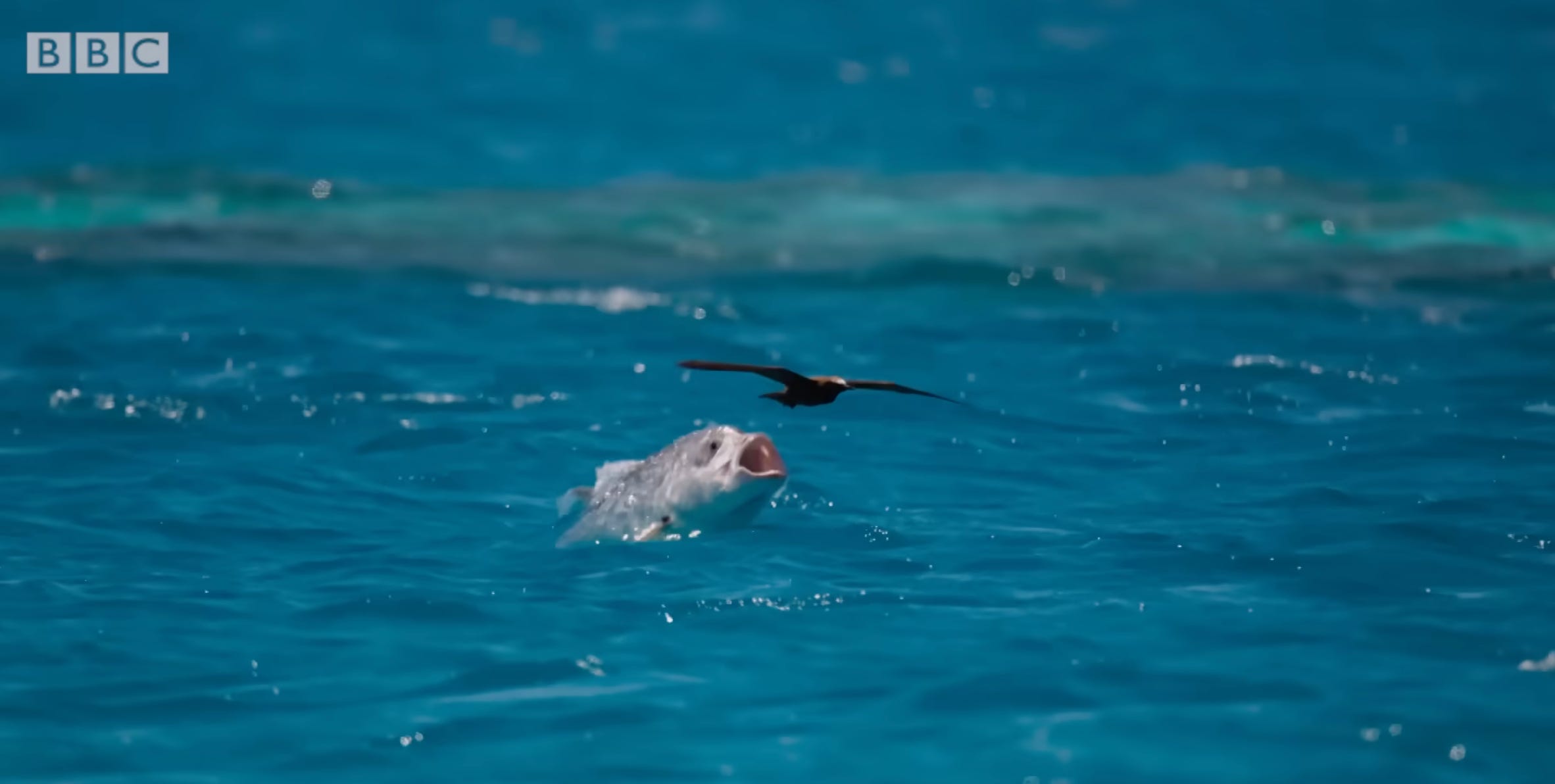
Why? Fabricated information is easier to make. It is cheaper and faster to create a TV show where the storyline and set is entirely fabricated than it is to send wildlife videographers to the Seychelles to catch a video of the giant trevally (an incredible fish that eats birds).
It is cheaper and faster to generate scripts about alien conspiracies than it is to create a documentary that researches and animates the Byzantine empire.
Some friends of mine will argue here that media companies are choosing to create the easier things because the average person’s taste is not very sophisticated. But I would argue that there is still demand for the shot of the giant trevally jumping out of the ocean to swallow a bird (the video I linked has over 18M views!) and the visuals of Byzantine calvary in their historically accurate lamellar armor (a staple of every middle school European history class). The feeling of awe and wonder that the latter content creates is natural to humans, and I would wager that if we had more opportunities to feel wonder, and broadly to experience more complex creations, we would choose to experience them.
Why do the harder things now?
Staying in the realm of content creation, I close my eyes and imagine that there are three vertically stacked shelves on a wall holding varying complexities of content. The first shelf holds the “let me get my tripod and talk to the camera from my room” videos. The second shelf holds the more ambitious projects, a short film, an original musical, an animated series. And the third shelf holds the most ambitious projects, the Christopher Nolan feature films of the world.
Everyone can reach the first shelf. We can all film a video of us getting ready or interviewing people on the street. And so most people who are interested in content creation will flock to create first shelf content. This makes the first shelf super crowded and competitive—every day I see yet another person in my YouTube shorts holding a tiny mic, doing a voice over red carpet looks.
The second shelf feels much more distant. The short film, the original musical, the animated series. They require doing research, writing a plot, editing and revising, more choices, and more intention. And what if whatever I produce doesn’t land with people? Forget climbing to the second shelf, I’m going to stay on the first one.
But then enters AI. Suddenly, it is so much cheaper and faster to do research, write an essay, create video assets, analyze data, design graphics, and execute computer tasks. And this brings down the complexity of both the historically easy AND hard projects, the harder ones comparatively more.
The two minute get ready with me and street interview were easy to create and still are. The short film, original musical, and animated series were difficult but now feel closer to reach. The time it would take for me to research a concept can now be cut in half. The graphics and editing that would require me to hire someone can now be done myself with some patience and prompting.
With AI, you can choose to have a “get rich quick” mindset and increase the number of first shelf content you create for the chance it goes viral. Or you can look at this technology shift and see an abundance of ladders laying on the ground. You can choose reach for the second shelf content, to create the things that always felt too big or something you could only do if you had experience and stepping stones.
I dream of the day when I wake up and see my life filled with second and third shelf things. The things that someone sat and dreamed about. The things someone obsessed over, every detail chosen and placed.
I hope we all choose to do the harder things.
If you made it this far, thank you for reading my June essay. If you have questions, opinions, experiences about any of these topics, I would love to discuss! That’s why I write after all :) You can find me @jjanezhang on X.
A special shoutout to my friends Leona, Blake, Orestis, Alex, Maya, Andrew and Amy!
Other topics I thought about but didn’t write about:
1.
Switching seats on the Titanic. I was sitting with my friend in Alamo Square park when he brings up that his team at work, a team he was once so excited about, was getting disbanded. I felt disbelief. How did this happen? Could you talk to all the people on the team? Figure something out, target another launch? He kept describing all the efforts he tried, and I kept asking questions. Then he says that, at this point, he was just switching seats on the Titanic. Suddenly I understood where he was—an incredible analogy.
2.
I want to rewrite my last essay. I make a promise to myself every month that I will publish an essay. Last month, I choose to call my essay done, the phrase “perfect is the enemy of done” ringing in the back of my head. But after I posted it, I felt disappointed. There was a section I had tussled over for hours:
I can choose to feel like a shrimp in an unmovable ocean. Or, I can choose to believe that everything I notice matters, that my influence on our product is as great as my ability to recognize the things I can touch.
But believing this is only half the picture.
And the transition I wrote here still doesn’t feel right to me. I contemplate whether I should’ve posted something I wasn’t proud of, and remind myself that even though my writing is public, I can always go back and rewrite it.
I was writing about wonder recently. What an important thing to experience
Such a lovely framing with the shelves! I admire how much care and intention you put into your observations and am thankful that you share them with us :)