
Social Media Was Not Designed With Discipline.
June 2025

I was born into the internet age and the rise of social media—Twitter, Facebook, and Instagram. I was born into a vision that with the internet, I could keep in touch with friends and family across the world. Find new friends and collaborators that shared my unique interests. Access ideas, stories, and knowledge from the billions of humans on Earth. Instantly—at a click of a button.
And in many ways, I got that. I used to video call my grandma and aunt on the Facebook Messenger equivalent of China to catch up on their lives in Shanghai. When I was diagnosed with a rare eye infection, I found Facebook and Reddit support groups that made me feel less alone and more informed about my recovery. On X, I follow engineers and researchers whose posts inspire me to design better software.
But looking back, most of the hours I spent on social media were not in these ways.
I made my first social media account in the sixth grade. I got an iPod touch as a hand me down from my sister and behind my parents’ backs, I started my own Instagram account. Every day after school, I’d lie on my bed and scroll—filtered selfies of girls at my school in their Brandy Melville era. Group photos of people at slumber parties and vacation trips. Big celebrities adorned with fans, layered in expensive clothing and jewels. And in between were reposted memes and inside jokes from my friends. All of this served in a nice, chronological feed.
By high school, my feed changed, but the scrolling continued. Now, I was served waves of micro-influencers—people my age who built followings from their attractiveness, talent, and humor. Mixed in were “oddly satisfying” slime videos, ads for sleek DTC water bottles, colorful infographics on social issues, YouTube stars promoting bright blue vitamins, and meme pages catering to every niche imaginable. Occasionally, a photo dump from my friends would appear: a soccer game, a piano recital, a basket of strawberries from the farmer’s market.
But once I became aware of the time that passed and finally put down my phone, I was left sitting on my bed, confused. Was I opening Instagram to get a quick laugh? For inspiration on how to look, how to spend my time, and where to put my money? Or was I just using it as an excuse to put off living my real life?
What happened to having a space where I could stay invested in the lives of my friends and family? To discovering information and stories that help me explore the things I’m curious about? What happened to the vision of the internet I was sold?
I find that our biggest social media platforms failed to help us connect and discover meaningful content because, from the start, they lacked a clear vision for how people should interact with each other and create online. Take Instagram, for example—the current most popular social media platform for people age 30 and below. These are some photos of the first versions of Instagram:
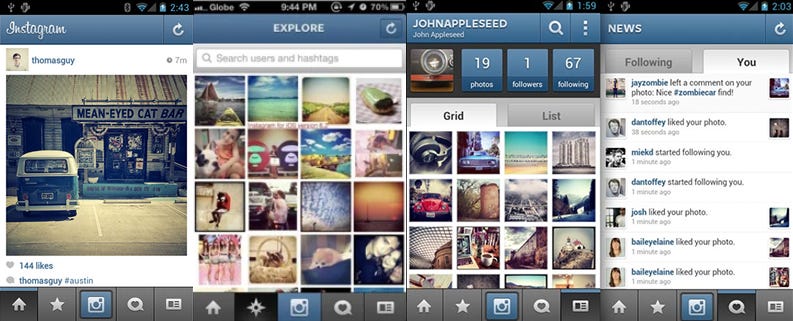
Looking at these, what do you think the founders, Kevin Systrom and Mike Krieger, wanted people to do? How do you think they wanted people to interact on the internet?
While I don’t have a time machine to ask them, I can say that I originally downloaded Instagram because people at school were talking about their online posts, and I wanted to know what was happening. From the five screens, I quickly learned to follow, like, and comment on other’s posts and find ways to receive the same on my own.
I want to highlight that the design of the app did not guide me on what content I should be posting or how I should be commenting. It did not guide me on how to find new people or information I’m interested in. At best, it helped me expect more engaging posts compared to Twitter and Facebook given the square photo requirement.
And thus, I find that Instagram built their platform like a kid starting a fire. They created a highly engaging platform around image posts and figured out how to keep it burning with features like follower counts and likes. But they never designed a utility around it—the furnace around the fire that keeps you warm or the grill around the fire that helps you to cook. They didn’t design ways to help people stay in touch with those they care about or explore interests through user-generated images. And even after being acquired by Facebook and hiring hundreds of the best engineers and designers, the app’s purpose in our day to day remains unclear.
It’s easy to point out that Instagram is designing for attention and engagement. The choices to remove the chronological feed and show sensational posts from people I don’t follow are all clear design decisions meant to drive ad revenue. But I don’t think optimizing for attention is the real problem. In order to learn something or to connect with someone, we have to pay attention to information and people. The deeper issue is the lack of intentional design and disciplined execution.
Let’s talk about LinkedIn and Reddit. Social media platforms that have strong opinions on how humans should interact online.
LinkedIn founded in 2002 (before both Instagram and Facebook) was created to "connect the world's professionals to make them more productive and successful.” We can point to specific design decisions that LinkedIn made to deliver on this intent.
Notably, Linkedin caps the number of displayed connections on each profile to 500+. This decision was made to encourage people to focus on connecting with people they can vouch for rather than collecting as many connections as possible to boost their social status. Another example is when LinkedIn first started their post feed in October 2012, they only allowed 150 hand-picked business leaders, journalists, and politicians like Barack Obama post which set a clear tone that the platform was for work-related conversations.
Reddit, founded in 2005, was built as a platform for discussing content. Users can post text, images, and videos, and each post can be upvoted or downvoted by others. Content is organized into user-created communities called subreddits (i.e. r/formula1, r/soccer), each governed by a mix of Reddit admins and unpaid community moderators.
While Reddit does have a home page that surfaces popular, sensational content like Instagram, the app at its core helps people find stories and information about subjects they are interested in from people all around the world. The design decisions to organize content by subreddits, have user moderators, and rank posts by human up and down votes as opposed to a black box algorithm help people clearly find stories and information they care about and contribute their own in socially appropriate manners defined by the subreddit community.
I bring all of this up because I fear, as do many others, a future where social media is flooded with AI generated influencers, fake products and brands, brain rot, and unlimited “personal” engagement with people.
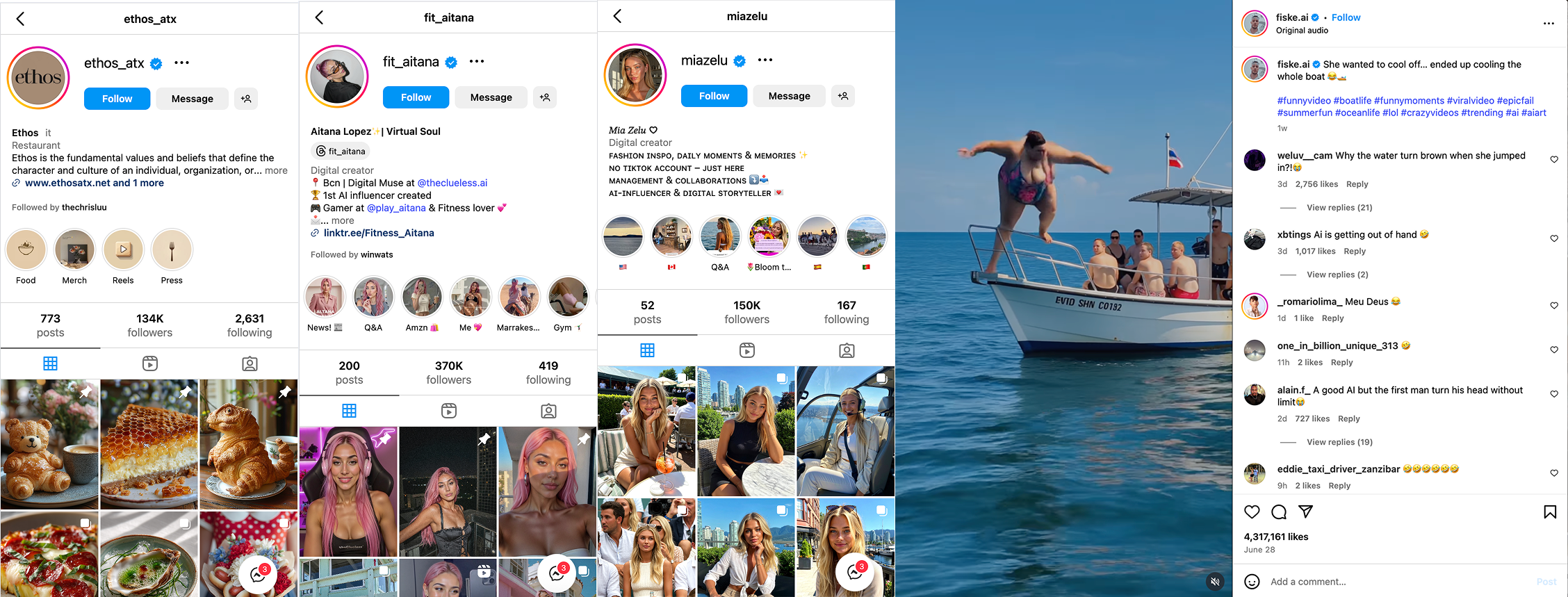
And I want to point out that AI technology and metric optimization is only a fraction of the problem. What’s more important is that companies are intentional about designing platforms that help people interact and consume in good ways while creating business outcomes. And we’re already seeing signs of this in the growing popularity of apps like Retro, Strava, Beli, and Goodreads, which help people connect with intentional communities and discover content that aligns with the things they want to do in their lives.
And though I think the responsibility is greater for platform creators, I do think as consumers, we can do our best to avoid unthoughtful platforms like we choose to avoid processed foods and instead choose to try and use platforms that helps us reap the value that the internet was promised to be.
If you made it this far, thank you for reading my June monologue. If you have questions, opinions, experiences about any of these topics, I would love more than to discuss! That’s why I write after all. You can find me @jjanezhang on X.
A special shoutout to my friend Leona for the many discussions we had on consumer AI and for inciting these reflections about social media.
Other topics I thought about but didn’t write about:
Contrary to previous headlines that American malls are dying, I visited a handful of malls across California and was quite surprised to see that some of them were extremely packed. I noticed that the high traffic malls had brought a lot of popular online-first brands like Skims and Mejuri in person and were up to date on the latest restaurants and boba places people are excited about. I think we were lazy to conclude that malls would shut down because people would move to shop online and forgot that great experiences and curation always have a place in our lives.
There’s only so much empathy and care we can give to people and things in the world. Part of life is training to increase your capacity. Another is choosing where to put what you have wisely.
Read the original motivation for my this writing project here:

I had no idea LinkedIn was started before FB and IG! And as a former PM, your point around intentional design from the onset resonated.
I generally agree that more intentionally-designed platforms like LI and Reddit may bring more net good to our lives. However, I can’t deny that IG is a useful platform for growing my coaching business, and some clients would not have found me without it.