
Stories from Shanghai
November 2025

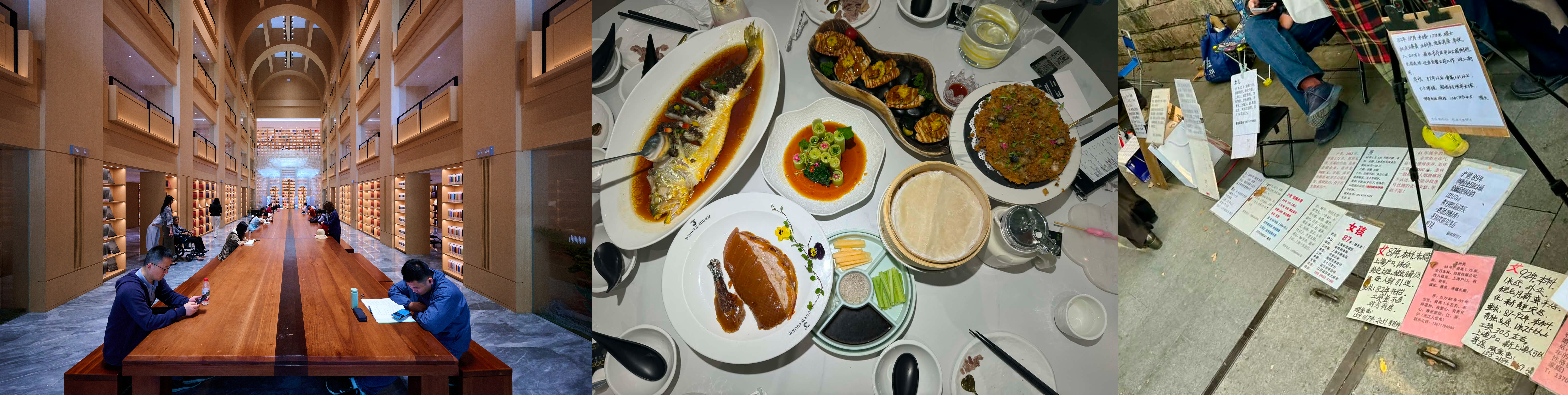
The Zikawei Library
My sister, aunt, and I swiftly ran across the crosswalk, dodging a food-delivery motorcycle and a woman in a gorgeous white wool coat.
Out of breath. We took small steps. Carefully entering a doorway surrounded by glass panels.
I felt the smell of a warm cabin. Around me, bookshelves in blond oak fell from ceiling to floor. Spines of Chinese war recounts and dynasty lore lay neatly on each ledge, warm lights peeking from behind. A handful of books were given their own wooden thrones. Limelights shone on each cover proudly, like a bookstore window display. I flipped through a couple, admiring the monospaced characters. Each page was crisp and thoughtful.
We walked up the staircase, and I noticed the plants on the walls—plastic, I assumed. But they weren’t. My delinquent fingers sank into wet soil and felt flowers so deeply purple. I can’t remember what books were on the next floors; I had been up since 7 a.m. But I remember climbing blond stairs to the top floor and seeing records collaged along the wall, some still in their covers—Elvis, Ellington, Liszt—others simple black discs with jeweled centers.
On the top floor, I spotted the names Brahms and Wagner among the Chinese characters, delighted to find the section of every bookstore that I go straight to. I pulled out the sleeve of books on Brahms’ works and sank into a chair. I carefully lifted each thin sheet of paper, recognizing maybe one out of every five words.
There is something so beautiful about a language where each word is the same length, the same number of syllables, yet can convey as much—or more—meaning with less ink than an English word.
I made a mental note to learn each word I skipped. I closed my eyes and let the warmth of the display lights scatter across my face. The rest was silence.
The EENT Hospital
Earlier that morning, my mom and I got up at sunrise to go to the Fudan EENT (eye, ear, nose, and throat) hospital for another opinion on my eye scar. Two subway lines. A twenty-minute walk. A security entrance, with overhead announcements declaring numbers.
Then, translucent sheet curtains—the kind Costco used to hang in front of its refrigerated produce section. We parted the plastic rectangles with our elbows and joined box-office-style lines to pay for my appointment and a hospital card. At least a hundred people waited in a dozen queues beside me. Parents with kids. Kids with their parents. Some were in visible pain, kitchen towels taped over their eyes.
An elevator carried us up to the eye-clinic floor. We walked out to a flurry of people: kids running in circles, parents yelling at staff, employees shouting into business calls. We dodged them all and waited at the machines, where I scanned my hospital card and retrieved a number.
My number followed the only English name announced on the speaker. We carefully opened a classroom-like door to the eye specialist’s office. Inside, six people sat at desks typing in the dark. One patient and their family spoke with the doctor while another sat on a greyed green couch. A staff member glanced up from her screen. She asked me why I was visiting and scribbled six tests on a piece of paper. Not a doctor, but doctor’s handwriting.
Down again to the lobby. Another line. Another payment.
Room A. Get number. Wait for number. Eyeball image.
Room B. Get number. Wait for number. Pressure recording.
Room C. Get number. Wait for number. Say whether E faces left, right, up, or down.
Once again, I was back at the eye clinic. I clenched my number and sank into a pleather chair, ignoring its peeled surface. I then watched as the white wallpaper curled from the corner of the wall into a rusted brown. An hour passes.
Ten minutes with the doctor. Then I was dismissed. To make way for the next patient—an elderly woman. I recognized her son, he had sat arm to arm with me in the waiting room.
Her photos—they looked ten times worse than the worst of my eye infection.
Family Dinners
I held my mom’s hand as we walked into a room that looked like the inside of a vertical farm from the movie Passengers. The walls were mirrors. The floor was made of transparent tiles with white sand and small green plants sprouting from beneath. We followed the rest of my extended family to a glowing table for seven.
As per usual, dinner began with a QR-code menu. My dad and uncle held a small congress over what to order. There was always a whole fish, head to tail. A large meat dish. A quarter goose. A duck. A big bowl of soup to share. Many side dishes. The first dish always arrived within five minutes of submitting the order.
While they were in session, I sat and watched a floating disc above my head display scrolling marquee text: “Warehouse No. 3.” Someone had sat down and thought, Let’s make a futuristic dining experience, complete with pastel drinks held by astronaut figurines and dessert plates featuring petit fours on cloud-shaped mirrors and cotton candy on tree trunks.
But when the marquee wrapped around a fifth time, and I became disenchanted. Just the day before, I had sat among tropical plants and bamboo huts and watched a man slice open a fresh coconut, pour the water and coconut meat into a pot, and drop in raw chicken and live prawns—their legs still visibly moving before diving into the bubbling water. My aunt remarked both times that the restaurant wasn’t as busy as the last time she’d been. It seems spells here don’t last very long.
Without fail, I came back from the future stuffed like a turkey. For less than twenty USD.
The People’s Park
Another afternoon, my aunt, sister, and I went to 人民公园, or The People’s Park. My sister had seen videos of parents posting advertisements about their single children on umbrellas to match-make. I imagined we’d see 10–15 umbrellas—maybe people not inclined to use technology. But reality was a sea of parents. Hundreds of mothers held posters and walked around judging other people’s. Every pathway in the park was lined with pink, white, and yellow sheets:
Name
Year of Birth
City of Birth
Height (cm)
Yearly Salary
Housing Status: Do you own a home? Does it have an elevator? Is there a mortgage? Do your parents live with you?
Desired partner’s height, city, salary, housing details.
No pictures. Few personality blurbs.
My aunt translated the posters for my sister and me. We were interrupted by several middle-aged women who poked my jacket:
“What year were you born?”
“Are you Shanghainese?”
“What are you looking for?”
“Let me help you.”
I tried to ignore them, but eventually one enthusiastic man realized I wasn’t a local and nudged us toward the “foreigners” corner, where I saw people who had moved to Shanghai from the US, UK, Australia, Germany—everyone looking for someone to marry. My aunt joked that my sister should write a poster for me.
Mahjong
Later that evening, I was sitting at my aunt’s dining table with my sister. We were debating whether we had stomach for dinner, so my aunt whipped out her phone and ordered boba tea and red bean soup to the apartment. Fifteen minutes later, a plastic spoon was in my hand and I was slurping chunks of taro dripping in a deep, purple-red soup. I was still hadn’t processed whether my sister and I should eat dinner.
After the three of us shared a bowl and a drink, my aunt suggested we continue our mahjong game from the night before. My uncle, who had just rushed in the door from work, said playing mahjong at home wasn’t very “comfortable”. He called someone and booked us a mahjong room.
The walk was about 10 minutes. My uncle was particularly excited that he had reserved the room with windows. And indeed there were windows, overlooking sparkling towers in the Shanghai skyline. I sat down at the mahjong table and pressed a button in the center. Stacks of eighteen tiles for each of the four table sides rose to meet us. Two dice rolled without our hands. Meanwhile, my aunt flipped through bags of complimentary tea, asking whether I preferred rose or lychee oolong. I laughed.
Graves
When I think of the word grave, the first image that comes to mind is a skull with crossed bones floating in cold gray air—maybe a spider web stretching over a mossy tombstone.
But that image contrasts starkly with my grandparents’ graves.
We first visited my father’s parents. I walked into a garden where trees were wrapped in gold foil. Golden ginkgo leaves showered us. Neatly laid cobblestones paved the way, and small waterfalls fed into ponds where koi fish played. We listened to gentle classical music through overhead speakers as we searched for my grandparents’ tombstone. We 扫墓 (tomb-swept), carefully arranging flowers, fruit, and their favorite snacks. We then lit incense to “send” these offerings and our words to them.
At my mother’s parents’ cemetery, we folded small paper gold 元宝 (ingots), placing them in a red bag that my mother sealed with toothpicks. Then we burned it to give my grandparents money for the afterlife, chanting for them not to be frugal. There was literally a “bank” at the cemetery designated for this rituals. Then we walked past stone gates to a beautiful lake and mountainside, with paved stairs where each family rests. We found my grandparents’ grave, cleaned the dust, laid flowers and fruit, opened bottles of orange juice and tea—apparently my grandma loved orange juice and my grandpa frequented tea—and let the incense burn out. We cleaned the ashes and left the serene back to the city.
If you made it this far, thank you for reading my November monologue. If you have questions, opinions, experiences about any of these topics, I would love more than to discuss! That’s why I write after all :) You can find me @jjanezhang on X.
A special shoutout to my friends Amy and Luke and my sister Joyce for being part of my life.
Other topics I thought about but didn’t write about:
Take time off. I look about two weeks off this Thanksgiving and even on my first day off, I sat down to write and had so so many ideas that I wanted to work through. I also just noticed the small things like a pair of labradors and a holiday decoration :)
What do we really mean when we describe someone as mature?
One of the ways I feel people’s intelligence is when they are able to distill what is important about my question or story.
Read the original motivation for my this writing project here:
Sharing My Internal Monologue

I’m not naturally one to relive the past. Moments, even ones I remember feeling strongly about, feel so far from me even just a couple of weeks after they occur.
The descriptions of your experiences are so vivid!
I especially loved your mullings on characters, word length, and how much ink is used to convey meaning!
I just arrived home in Shanghai for the holidays! Never clicked to read a Substack so fast