
What is My Life?
February 2026

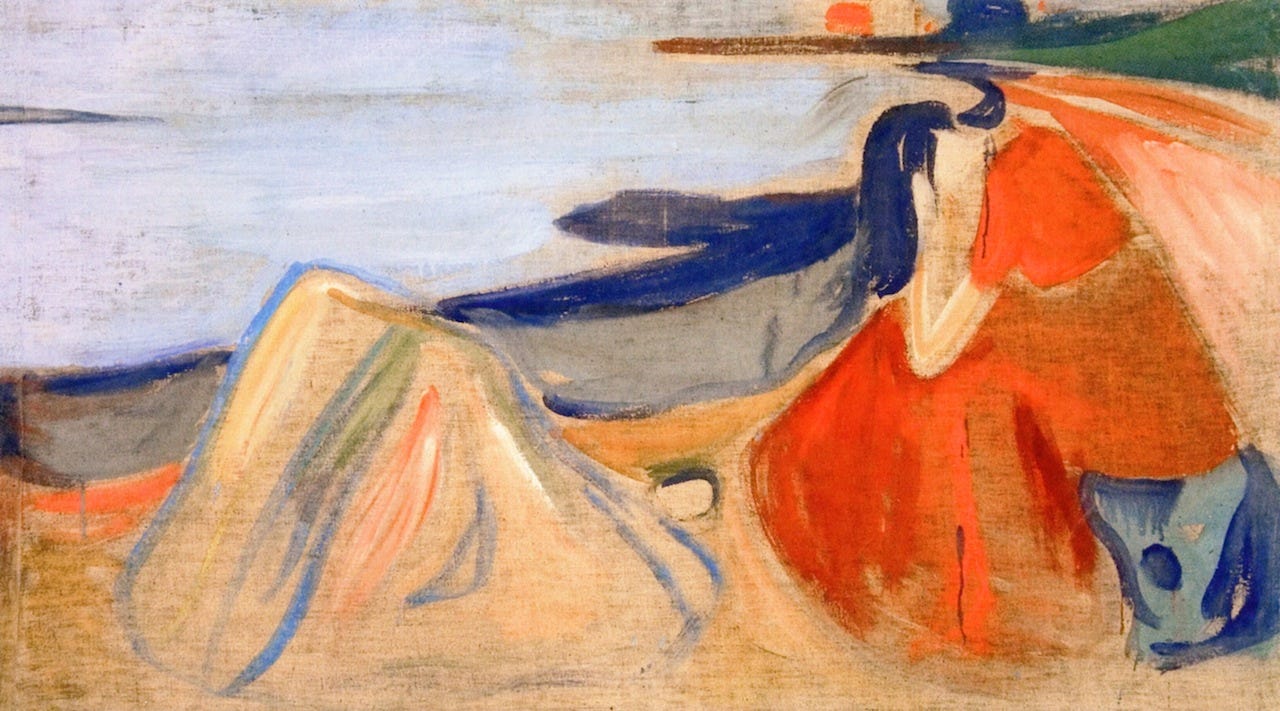
Some days I wake up, and I feel at rest. Like Newton’s first law—an object at rest stays at rest. I feel still in my life. I feel calm. I take care of my health. I take care of my friends and family.
That’s all there is.
Today, I woke up to some mild stomach pain. Not too bad. I committed to going on a hiking trip with some of my friends, so I got to their house 15 minutes before the agreed departure time, and together we hiked Point Reyes. I drank plenty of water. I only had a spoon of the buffalo milk ice cream as to not further upset my stomach. On the car ride there and back, we talked about how we’ve changed, how we played as children, and what we wanted to teach our own. The views were gorgeous. But even then, my care for my body and my friends painted my Sunday.
This is my life. If I blink a couple more times, I’ll wake up at 7am. I’ll eat a hard boiled egg and sip on some ginseng tea. I’ll drive my kids to Chinese school and run multiplication tables with them. I’ll call my mom while I sit in the car, waiting for school to end. And when she runs out of topics, I’ll bask in the sun glowing from the car windshield and read my partner’s writing. Caring for myself, caring for my loved ones comes naturally. I’m human.
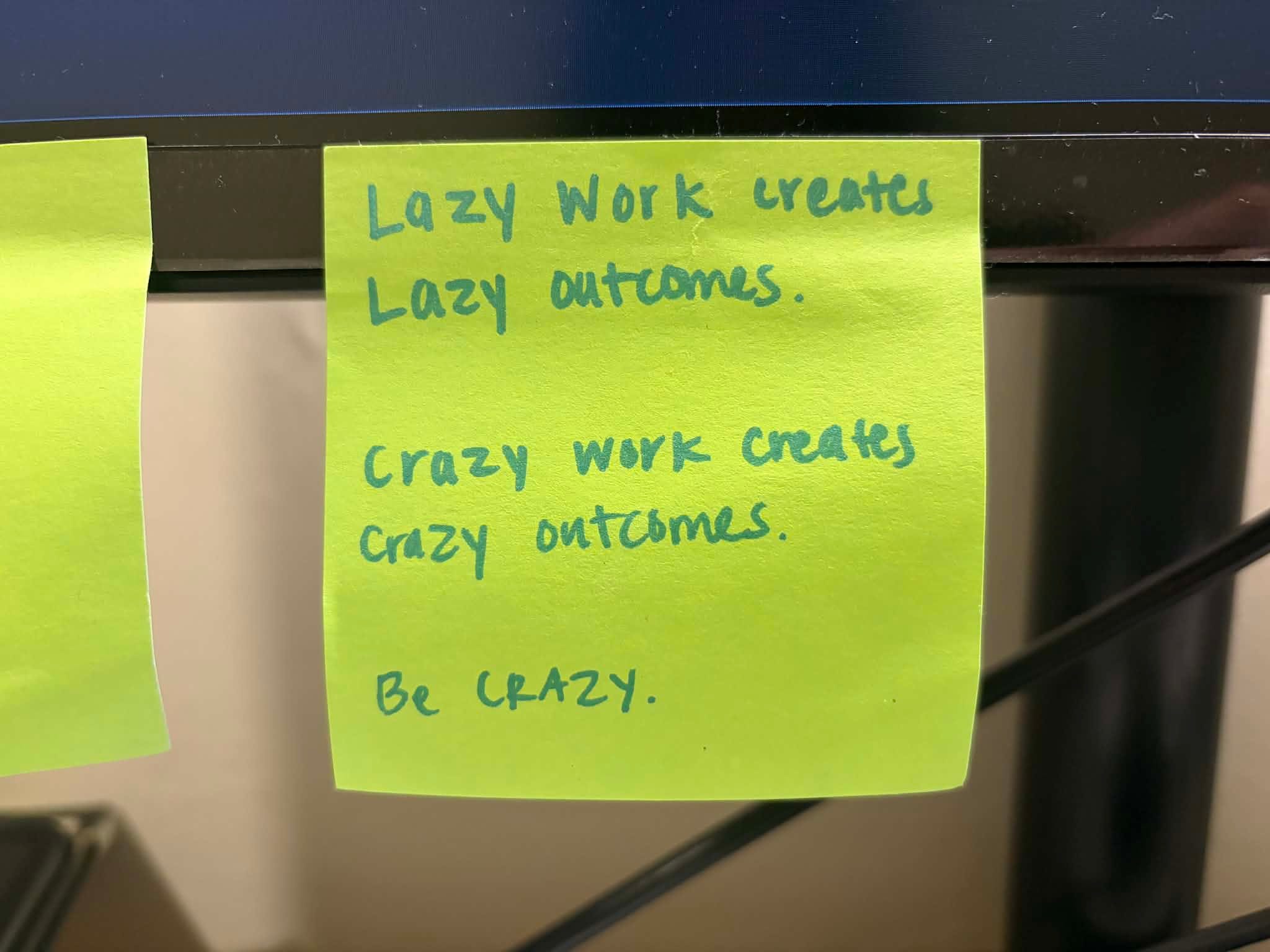
Some days I wake up, and I feel in motion. Yesterday, I ran my four mile half marathon training run while listening to Stephen King’s Carrie. I ran home, I showered, I sat at my desk. I read the sticky note my sister put on my monitor:
“Lazy work creates lazy outcomes. Crazy work creates crazy outcomes. Be crazy.”
I looked at my screen. My eyes didn’t immediately focus. My scarred left eye overlaid blurred text over my right eye’s crisp letters. I sighed, I felt sad. I breathed in, I felt motivated. I remembered my conversation with my doctor. The one who told me that I’m lucky for how well I recovered. The same one who told me there was no way to cure my vision. No research he saw that was promising. No hope I could latch on to. I thought about the other people. A handful of my closest friends, some strangers in a Facebook group. They were told the same thing about their illnesses. I didn’t need a McKinsey market sizing exercise to know that I wasn’t alone. I felt that no one was going to advocate for us safely, with high integrity and care, with deftness in applying AI, if not me. I opened my project to help people fight through multi-month recoveries. I worked until midnight.
Some days, I wake up, and I feel inertia. My priorities are straight enough that I’m rarely in motion and fail to be at rest. But sometimes, I am at rest and feel resistant to being in motion. I feel happy just being with my people. Around them, I feel gentle, patient, and kind. A cat that tip toes across the room and curls up beside you. A running brook, flowing quietly amongst trees.
And in this moment, I feel distant from the part of me. The part that is eager, exasperated, ablaze. A dog that leads the chase. A canyon wall, reaching into the sky. But I know she’s there.
Origins.
My mother likes to say that I am a sweet girl. That whenever I got some desert like a chocolate chip cookie, I would break a piece and wait for my sister to come home so I could share it with her. As a kid, the only things that mattered to me were my family and my three friends. What my parents and my sister said, how my friends felt—that was my entire world.
Then in high school, I started developing a relationship with the world. I was nudged toward clubs that advertised “building robots to change the world”, “building companies to change the world”, “debating topics to change the world”. I read books like 1984, The Grapes of Wrath, The Kite Runner by authors who brought people, ideas, and inequities far from me close.
I remember in my 11th grade English class, we read Johnathan Edward’s Sinners in the Hands of an Angry God—an impassioned sermon comparing sinners to spiders being held over a burning fire, the web held by God. We were instructed to write our own sermons, announcing something we believed in for our class to reflect on.
I stood in front of the class and urged my classmates to study entrepreneurship in high school. I said we needed to learn to fail amidst the boiling pot perfection of SAT scores and college applications. We needed to see that we could create for ourselves and others, and realize that that was all that really mattered. I believed we needed to bring entrepreneurship education everywhere and started our high school entrepreneurship club. I spent my summers teaching at startup camps. I gave lectures and played mock board member to students. I really believed in it.
The peak of my global mentality came in college. During my sophomore year, I returned home for winter break. I sat down at the dining table with my mom and sister. I remember my mom bringing up again that I’m naturally very sweet. And I remember rejecting it. I said I didn’t feel like a sweet person. The descriptor was incorrect. Just a week before, I had fired someone from a club because they weren’t meeting the expectations I set. I felt ruthless. I cared about getting things done. There were too many problems to solve and things to create. I excused myself from the dining table and went upstairs to work.
Then I graduated. I watched my friends make the choice to start companies. To stay in their offices instead of sleeping. To see their friends less, and their parents even less. In my own whirlwind of work trips, I woke up one day and lost my vision in my left eye to a rare disease. My sister, my friends, they all started coming over to my place multiple times a week, just to hang out with me while I sat around the house and recovered. I called my mom every day to tell her about my symptoms, to feel her next to me, fighting for my recovery. My parents, my sister, my friends—they became my whole world again. I loved just being with them and thinking about them. I made friends again with the girl who’s favorite part of her day was sharing her cookie with her sister. And now I wake up every day and choose to be her.
Mastering the forces.
Having lived both extremes, I have learned that I’m unwilling to wake up one day and see that I’ve built great things for millions of people at the expense of caring for myself and those closest to me.
But I also haven’t given up on my ambitions to work toward a mission greater than me.
It is objectively hard to balance caring for yourself, your partner, your kids, your parents, your siblings, your friends, and the people in the world. To believe you can do it all, especially well, is to be naive.
But I have friends, quite a bit older than me, who do work on projects and companies with ambitions far beyond themselves. Yet, they also nurture a rich life with the people they love. I know they aren’t perfect. They tell me about the nights they were impatient with their kids, and the mornings they forgot to embrace their partners. But I find the people that forwardly take on this challenge to master their local and global selves the people I most aspire to be.
I don’t ask them for their secrets. I’ve never understood how I wanted to live my life from someone else’s verbal wisdom. Instead, I find that I understand how I want to live when I touch, feel, think, and live life on my own.
And I’m understanding that the force that shifts me from rest to motion is one I control. One I can train. A muscle to be present with the people closest to me and bold when I create for people in the world. I choose to feel my sister’s emotions with her, to hug my parents, to smile with them, to tell my friends how they make me feel. As much as I choose to design great software, to have conversations with strangers about their health recovery processes, and to believe that I can help people recover from seemingly incurable diseases.
My life is to master both.
If you made it this far, thank you for reading my February monologue. If you have questions, opinions, experiences about any of these topics, I would love more than to discuss! That’s why I write after all :) You can find me @jjanezhang on X.
A special shoutout to my friends Amy, Andrew, Annie, and Leona.
Other topics I thought about but didn’t write about:
I had a bit where I was thinking it could be fun to compare my at rest self to Monet’s Impression Sunrise and my in motion self to Edvard Munch’s The Scream. But then I decided this was more of a fun visual than honest. I would love to read all the parts that don’t make it into my favorite books.
It’s probably unadvisable to let someone or even an AI read your writing before you’ve finished a first draft. People, and now LLMs, will try to find meaning in bits of your story that you didn’t see meaning in, and this can distract you from writing what you see.
I am very excited about consumer AI. And I think we need to think carefully about how we create natural language interfaces. For example, I think switching from a free form chat with bubbles to screens with single generated questions displayed one at a time builds a more unidirectional relationship, the user always answering. And I think this can be an arguably safer experience.
Your will to think about things. I’m noticing what I naturally have a strong will to think about, how I live my life being one of them as I’ve written about here. Building relationships with people is another.
Looking for more? See last month’s essay →
We Don’t Need People Anymore.
I got eye surgery last week. Back when I first scheduled this procedure in September, I called my mom to give her the update. She immediately blocked off her calendar, bought plane tickets to arrive in San Francisco the day before my surgery, and started a list of things to bring me. Sunglasses. Face masks. Daikon. And other Asian ingredients.
Beautifully written
Beautiful read and insights!!! Resonated with so much of this. Thank you for sharing :)