
My Year of Writing
December 2025

I started this year acknowledging that I am not one to live in the past. I wrote about how I often lose past versions of myself—I forget what I thought about, how I felt, and what I cared about. And I wanted to change that. I wanted to keep a record of who March 2025 Jane was, for March 2035 Jane to read and appreciate.
And so I created this project to record my internal monologue, to write about something that confused me, something that I repeatedly thought about, every month this year.
I am elated to have kept this promise to myself. And even more elated to share how this project has changed me.
Dedicating time
Admittedly, I didn’t think too hard when I first came up with this writing project.
I was with my friends Alex and Maya in Miami on January 4th. We were walking to pick up croissant ingredients when we landed on the discussion topic of what kind of books we would write if we were authors. I talked about how I would love to interview my favorite artists and ask them what they thought about when they woke up, walked around the city, sat down to create art, and how their inner monologue changed throughout their careers.
And then I thought to myself, I don’t even know what I was thinking about just two months ago.
That was how the idea for the inner monologue project was born.
Since, I’ve dedicated approximately 150 hours of writing toward this project. In some sense, it’s only seven days of my life. But every month I set aside two Saturdays or Sundays to sit alone and write and a string of weekday nights to edit. It feels as if my life was anchored by this project.
Did I ever think about skipping a month or quitting all together? No. But I was forgiving with myself when it took me an extra two weeks to get something published.
And I think that forgiveness is important. Good things take a good bit of time, over a long time.
Finding my process
My writing time is between 9 and 6pm on a Saturday or Sunday in one of Kantine, Blue Bottle on Fillmore, La Boulangerie in Hayes, and a handful of others. My editing time is after 8pm on a weekday in my room at home. Every writing session, I exclusively listen to this impressionism playlist, and now my brain knows that the first notes of Satie’s Gymnopédie mean it’s time to write.
When I sit down to write, my best writing just pours out of me. And no matter how many times I go in and rewrite it, the first version always feels the best. It reminds me of how Lady Gaga explains that she wrote “Just Dance”, “Poker Face”, “Bad Romance”, “Born This Way”—her most popular works—in under 10 minutes. I understand this intimately now.
My sister likes to say that this phenomenon is called “channeling”. Like you created a tunnel between your head and the page and let your thoughts flood through. But I think it all comes down to this: writing is easy when you have something you want to say.
At the beginning of each month, I open a fresh Notion page. Whenever I come across something I want to think more about, I add a few sentences to it. Most often it’s something that crossed my mind during a conversation. Other times, it’s purely a random thought, one that just popped into my head while I was standing on the N or eating a banana in the office kitchenette.
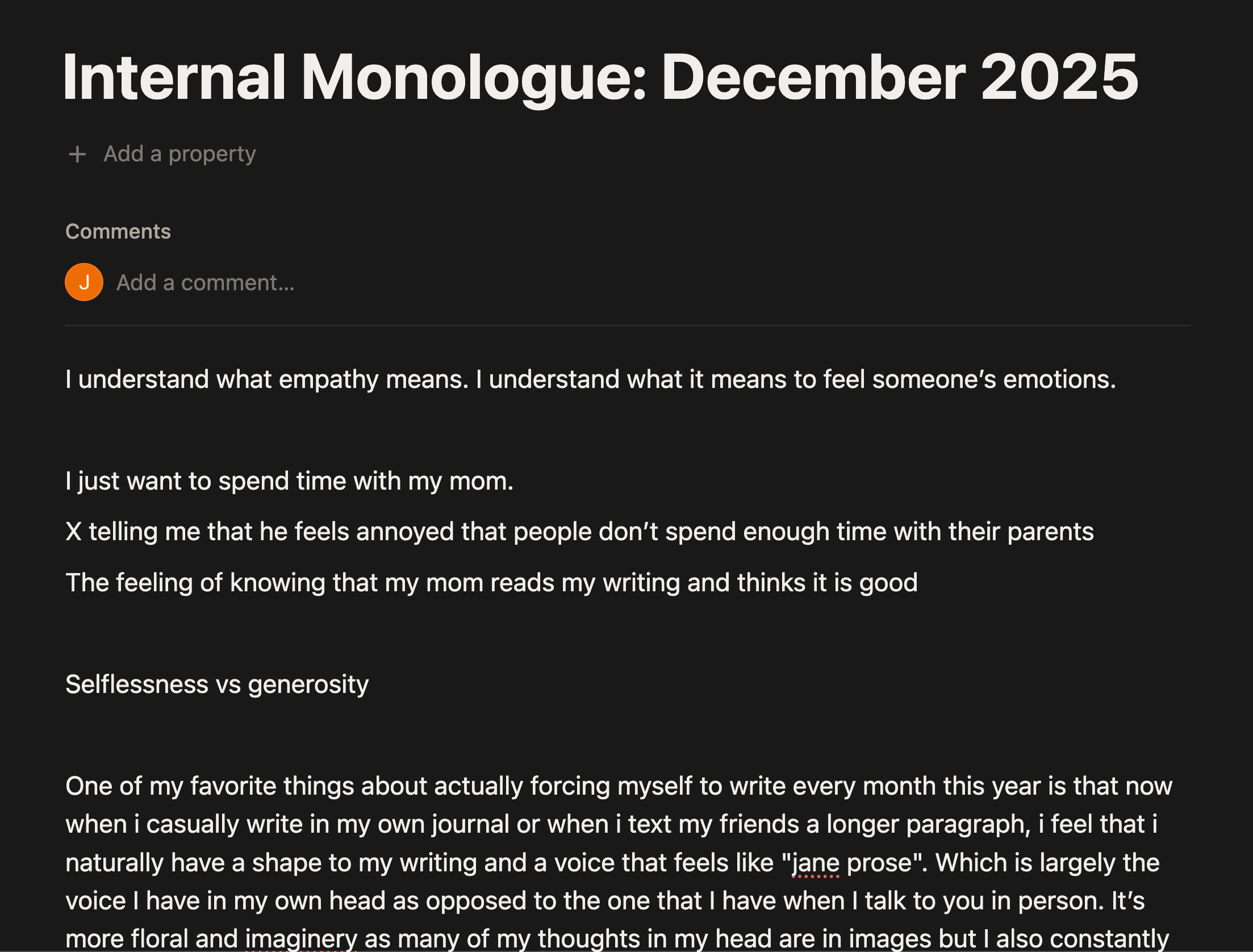
Then when it’s time to write, I choose the topic that I feel most excited to explore. Pointedly, it’s never the topic that I think people want to hear about nor is it the topic that seems the most timely. Writing becomes rage hitting the backspace every five seconds, vilifying the words on the screen, and watching the cursor blink when you don’t have something you want to say.
And inevitably, when this happens to me, I shut my laptop. I go on a walk. Lay on my bed. Take a shower. Contrary to “diffused thinking”, I don’t just let my mind relax in hopes that something will come to me. I instead actively have a conversation with myself. What about the topic is so confusing to me? Why do I care to feel less confused about it? What is it that I so desperately want myself and others to understand?
Sometimes when I’m really struggling, I will replay the physical scenes that led me to write down the original sentence in my Notion doc. I’ll go through when I first started to feel confused, who was around me, what street I was on, what I was listening to—all to help me get back to the place where I first wanted to say something.
I’ve also learned that when you despise your ending, just cut it and end. You likely already finished saying what you wanted to say.
Developing my own prose
One of my favorite things about committing to writing every month this year is that now when I casually journal or send my friends a longer text, I feel that I naturally have a shape to my writing and a voice that feels like “Jane prose”.
Jane prose largely comes from the voice and imagery I use when I talk and think to myself.
It is floral and embodied.
“My delinquent fingers sank into wet soil and felt flowers so deeply purple.” — Stories from Shanghai
It is uncertain. Sometimes inconclusive.
“I wonder if I’ve lost my original dedication to build what I believe people need in the guise of finding a great opportunity” — What Are We Really Building For?
It is gentle, yet serious.
“Impending great medical discovery, I will not be able to see that faces of people the way I used to, feel as carefree walking on streets, going on hikes, exploring new places as I did back in February of this year. I feel vulnerable by its purist definition.” — Life Markers
It is precise. It breathes.
“Then it happened. Ten days in, I woke up, I closed my right eye, and extended my hand in front of me. I saw nothing. I frantically wiggled all my fingers. But I counted none.” — Losing my Vision
All of these aspects of my writing style are direct reflections of my relationship with myself. When I replay images in my head, I replay them with more attention to detail and adornment than when I first experienced them. When I talk to myself about my feelings of existentialism and missing life direction, I sit in my uncertainty and acknowledge that I don’t have answers. And when I work through my feelings about my permanent vision loss, I let myself feel all the fear, envy, sadness exactly as I feel them. I don’t melodramatize the situation, nor do I play it off.
I’m not fully aware of all the literary tools that I carry. But I’ve practiced using them so often that when I write, I can feel when I want to pause a sentence. Go back and add a word. Or end a sentence. I feel a deftness with words that I’ve never felt before.
And I promise, I hand typed every single word I posted this year. I like to believe that I can write my way out of my problems, and ChatGPT is not going to do that for me.
People reading my writing
For this project, I didn’t really think about what I wanted people’s reaction to my writing to be. If anything, I thought about whether future Jane would actually enjoy reading what I was writing for her today.
But I’ve since discovered how good it feels to know that someone spent the time to sit down and read my words. To go on a thought journey with me, almost as if they pulled up a seat next to me, in my head, for a little bit.
I am grateful for my friends (you know who you are!) who will proactively text me and tell me something I wrote was moving for them. This year, I also loved being part of one of my college group chats (shoutout to the Cube Substack chat!) which has been both a joy to share my writing in but also has been a place for me to discover that a lot of my other friends write about their lives that I never knew of! And I find that reading their inner thoughts makes me feel closer to them even if I’ve never had a deep one on one conversation with them.
When my mom first told me that she read my February monologue, I felt a certain awe, and then I felt exposed. I had written a little bit about how I visibly noticed that she was aging. I distinctly remember her saying something along the lines of, “Do my hands really look that old?”
I think about that moment often. It both makes me laugh and also makes me feel deeply connected with her.
Most of my life with my mom has existed within a traditional parent child relationship—one that feels very unidirectional, your parent always looking down at you and you looking up at them.
But the image of my mom reading my inner thoughts about her and asking me for validation makes me feel a momentary role reversal. It makes me feel like we’re friends.
My life is more beautiful.
Last night, I was at a bar in downtown San Francisco. I sat down at a table across my friend. My eyes glanced passed his face to the lights that glowed in the crevice of the wood panels behind him. Lights glowing on wood like I had described in my last essay.
The day after, I was writing at Kantine when the lights went out. I packed up my stuff and started walking towards Mission Dolores.
I watched the water echo when I stepped my boot into each puddle. I listened to the rain drop around me and clutched my black polka-dotted umbrella like a shield. I felt invincible. I felt happy. Like a child.
I looked in front of me and noticed how the scar in my eye scatters all the lights on the left side of my view. How the reds, yellows, and whites pooled into globes. How every fine line and border between the sidewalk and the traffic light fades into each other. I closed my left eye and it all disappears. I opened my eye and it’s back. Like a super power.
I stopped to look at the bright creamsicle color of a victorian house on 17th and Church. I stopped to look at a small Japanese restaurant.
I stopped to admire the lights—the lantern lights that hit the bamboo walls.
If you made it this far, thank you for reading my December inner monologue. If you have questions, opinions, and experiences about any of these topics, I would love more than to discuss! That’s why I write after all :) You can find me @jjanezhang on X.
A big shoutout to my friends Jacob, Amy, Luke, Leona, Taneisha, Alex, Maya, Sarbo, to my sister Joyce and my mom for all being big supporters of me and my writing this year!
Other topics I thought about but didn’t write about:
It would be kind of fun to share all the excerpts that don’t make it into my final essay. Such as:
I remember walking down Masonic Ave earlier this year, listening to Healey Cypher’s podcast Don’t Be a Jerk. There was one episode where Healey talks with psychologist Dr. Faith Cohen about founder coaching. I remember him saying the sentence, “Is it like steeping in <something>?” Maybe the word was knowledge.
I felt a chill in my body at the word steeping.
And I made a mental note of it and used it in my August monologue, Life Markers: “Later that night, I walked out of my cabin to crisp air and trees steeped in dust and lacy vines.”
When you get older in life, you have more and more reasons to exploit what you have rather than to explore things. It’s easier to make more money staying in the field you’ve always been in. It’s easier and arguably more meaningful to maintain the same friends you have rather than making new ones. And people expect that as you grow older, you make decisions because of the 100 previous ones you made. But maybe the next decision you make doesn’t need to “exploit” all the past knowledge and experience you have. Thank you to Taneisha for this fun discussion topic.
Read the original motivation for my this writing project here:
Sharing My Internal Monologue

I’m not naturally one to relive the past. Moments, even ones I remember feeling strongly about, feel so far from me even just a couple of weeks after they occur.
150 hours is such a good reminder of how a relatively small time investment into a project can be life-changing
what a lovely ending to 2025! thankful that we got introduced to jane prose this year, it’s been so wonderful to read your reflections and insights and hear more about the way you view yourself + the world around you :) happy new year!