
What Are Humans to Do After AI?
March 2026

This month, I felt uneasy.
Uneasy, when my friend and I walked out of the gym and he said, “I’m selling all my stock and switching jobs. This is the last decade I can make money.”
Uneasy, when I caught up with two college mentees who told me, “We decided to drop out to start a company. This might be our last chance.”
Uneasy, when I met two separate friends for coffee who both said, “I think software engineering won’t exist in two years. I’m thinking about switching to policy.”
I sat down at my dinner table and my roommate said, “We should buy land and get citizenship in other countries.” I walked into my sister’s apartment and her partner shouted from the couch, “Jane, we must avoid the permanent underclass!”
A lot of this is fun and jokes, perhaps a way to cope through the absurdity of how fast our jobs have changed with AI. A lot of this is the product of living in the San Francisco tech bubble.
But it’s also not nothing. This week, I wrote less than 30 lines of code by hand. I started a dozen experiments with a poorly grammared sentence and woke up to fully finished benchmarks and recommendations that took me days a year ago. I’ve even started typing only the first three letters of words, knowing AI will figure out the rest.
Will I lose my software engineering job a year from now? Will a 24/7 always on computer always be more productive than me? Smarter than me? Are the days of the 6 figure, 9-to-5 big tech job over?
These are all plausibly true. But deciding “we are doomed” and surrendering to the catastrophic narrative of the omniscient AI feels too easy. It is easy to assert that the world will end. It is harder to assert what we want the world to look like in ten years.
I challenge us to be expansive. To think more creatively.
Will work look different? Yes. Will humans need to rise to the occasion and change what we do and how we create for each other? Yes. Will it be difficult? Absolutely.
But I think we all have it within us, and I believe AI is about to make our work a lot more fun.
To be human is to create for each other.
During my senior year of college, I studied with an anthropology professor at the University of Oxford. One afternoon, we went to the Pitt Rivers Museum, an anthropology and archaeology museum at the center of the university. I remember walking into a deep room with backlit displays of human skeletons, glass cases of woven baskets, a scatter of etched stones and arrowheads, masks with shells and beads, coffins, pots, costumes, jewelry. It wasn’t unlike other museums I’ve been too. I’ve often looked at such physical remains and thought to myself, “wow these are some well preserved things”.
But then my professor stopped and looked back at me with an uncontrollable smile—”We made all of these things!”
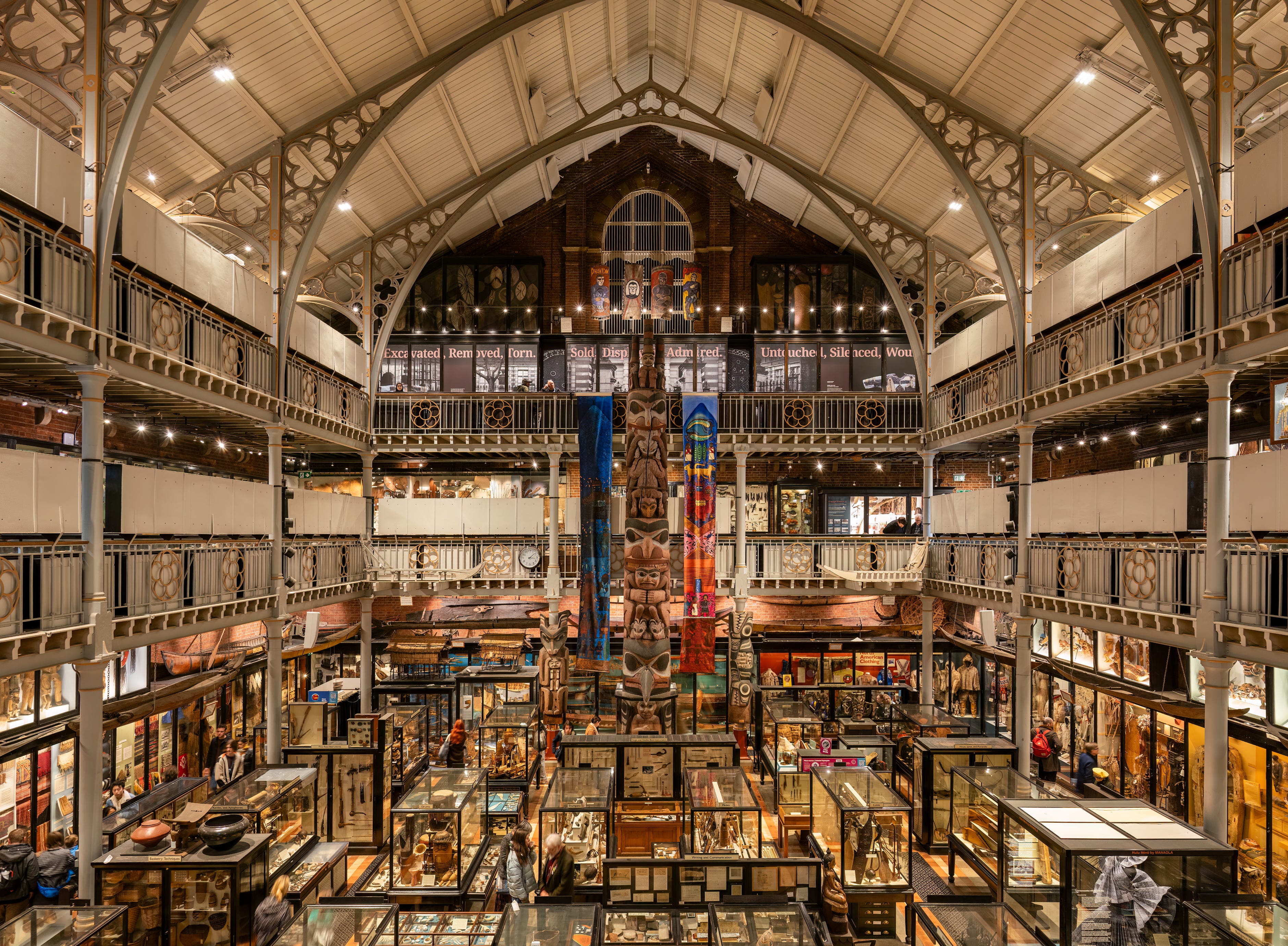
That turned out to be a poignant moment in my life.
I looked back at the display cases and felt, so suddenly, a new appreciation for humans.
We create stuff! No other animal does this anywhere close to the same extent. And we continue to create more and more, building upon what the humans before us created with even greater complexity—cultures and languages, computers and cures. This room was just a small piece of evidence for what is so extraordinary about humans: we create things for ourselves and others.
I spent a semester writing papers about this phenomenon. Some scientists, much more researched than me, argue that its our increased cognitive ability that makes us creative and problem solving. Some point out how homo sapiens were uniquely possessive about their creations. How we would tinker with a stone, carry it around, and share it with other humans while other animals would forget their tools and create new ones from scratch each time.
In any case, everywhere you look is evidence that to be human is to create for each other. So long as we feel the affects of our choices on ourselves and other people, we will continue dreaming up ways to make our fellow humans feel something and to help ourselves be felt. Infinite intelligence is as boundless as the towering mountains, unpredictable creatures, and endless oceans on Earth. We turned these things into stone tools to protect ourselves and costumes to experience the lives of those we don’t know. And we will continue to use AI to protect ourselves and to experience more of the life we don’t know yet.
The dream job.
I dream of the day when my job is to wake up, sit at a desk, access this all knowing AI portal, and start asking it to simulate all the ways it can put my ideas out into the world. And because executing any one of these plans can cost many resources and cause irreversible changes, my job as a human is to work with other humans to choose the best plan to execute for people today and the people that come after.
I intentionally point out that humans will be the “go button” pressers. There is always one state of the world at each point in time, and we want to choose what that is because only we will feel the effects of our decisions—the AI never will1. The time someone spends growing up before they get a job is no longer a period of technical skill building, but rather a period of understanding and exploring what we want human life to be. We focus less on learning how to change the world, and instead focus more on forming opinions about what we want to experience in the world.
I often think about how incredible it is that no one has lived the same life. How your unique n years of indeterministic, compounding experiences are the most valuable asset to yourself, the people closest to you, and if projected at scale, the world. How I began to fall in love with writing when my 10th grade English teacher showed me how Aldous Huxley described birth with the colors and sounds of death. How I learned to deeply value and commit to friendships when my friend Jessica chose to eat with me the second day of college and every day after. How I discovered that recovering from illness is truly a battle after I woke up to blindness in one eye.
It is the culmination of all these moments that give me opinions about what I want other people to experience. I want people to enjoy my inner thoughts and their own when reading my writing. I want people to feel the joy, comfort, and invincibility that I’ve experienced in my friendship with Jessica. I want people to feel powerful when they are fighting to recover from illness.
In a future where there is no barrier to knowledge, expertise, and creation, I want companies to become congregations of people who care deeply about a specific aspect of human life—how we maintain health over time, how we stay sheltered, how we find love, how we power computers and data centers—and our work becomes sharing our formed opinions, using AI to simulate plans, debating which ones to execute, pressing the go button, and experiencing whether our efforts make each of these aspects of life better and richer for us.
How do we rise to the occasion?
On the path to reaching abundant expertise and execution, a lot of our day to day work will become automated, and we must adjust.
I see two arcs to grow along. The first is to become people of high trust. The second is to become people who dream.
Over the next two decades, AI will improve likely to the point where it can create outcomes as consistently as pressing 1+1 and receiving 2 on a calculator—we are already beginning to see that consistency with self-driving cars.
But in the process of getting to that point, humans will still be accountable for the outcomes of AI. A human will be responsible for determining when AI is ready to teach our kids, monitor our electrical grid, and diagnose patients autonomously because we know that if we make the wrong decision, we will feel pain.
The AI, it feels no pain. It has no life to lose. If it makes the wrong decision, all it can say is “You’re absolutely right!” and append feedback to its memory or model weights. When AI starts planning decisions that affect millions of lives, our job will be to understand, verify, and feel confident pressing go on those plans and to take responsibility for any lack of foresight. Our employability becomes how much we can be trusted to ensure the right outcome. The best way to improve at this is to take the decisions you make seriously and to want to make decisions yourself—are you be willing to stamp your name on a decision knowing that if you made the wrong call, X is at stake?
Today, creating new experiences falls to a team of junior people who analyze data and build product, with a leader who is held accountable for the outcome. Given that analysis and work is automated by AI, we must increase the number of changes and bets we make, otherwise analysts and builders risk being displaced.
Luckily, there continue to be endless problems that inspire change; we created the abstraction called money which gave us incentive to feed an entire world of people, but has also created loneliness, doubt, and greed. If executing work becomes trivial, can we look difficult problems like loneliness straight in the eye and create ways to help people enjoy being with each other? Can we create a world where people don’t feel alone?
If you wake up today and fear that AI will take your job, you can instead redirect your fear and be part of the solution. You can get into the practice of thinking about what in your n years of life you wish you experienced more or less of. You can become a person who dreams and is trusted to make those dreams a reality.
What do you want life to look like after AI?
If you made it this far, thank you for reading my March essay. If you have questions, opinions, experiences about any of these topics, I would love to discuss! That’s why I write after all :) You can find me @jjanezhang on X.
A special shoutout to my friends Jessica, Suchir, Randy, Amy, Andrew, Kunal, Lynne, Jacob, and Janice! Every single one of these people nudged my world view a little bit this month, and being with them makes my life more beautiful.
Other topics I thought about but didn’t write about:
1.
Does our generation live too carefully? My friend Randy and I were chatting on top Salesforce park when he pointed out to me that our generation lives more carefully than our parents. I was taken aback. I see my parents as conservative, easily-worried people. But then I remembered how they moved from Shanghai to the US, without really knowing America. In contrast, I and the people around me are much more calculated. We pay a subscription to take our blood and tell us what to eat. We construct crystal balls and expeditions to craft a career with meaning and financial upside. We talk about how to maximize our 20s and how to have the most fun. I almost want to stop it all. And just live life.
2.
Living life. I know it sounds simple. But I am starting to feel it more. When I say I am living life, I don’t mean giving up my responsibilities and following my impulses. Instead, I find myself following my current curiosity, happiness, and rage rather than designing and chasing future me. That means following the rage I feel around healthcare—filling my ears with audiobooks about care navigation and stories from healthcare founders. That means exploring this new found easiness I felt while dating someone—talking to friends about how they feel love, writing about what it means to me, and enjoying it. I’m intensely following what I feel, and the phrases living fully and richly begin sticking to my inner eyelids. I am living life!
3.
Microdosing heartbreak. I experienced a breakup after being with someone for a month. While the conversation was unravelling, I cried into his shoulder, but I also smiled. I looked up at the stars and thought about what made him special to me. I enjoyed his warmth and said everything that came to my mind. When he walked me home, I held his hand and pointed to his name in the street signs—“Look, it’s you!”
I awoke the next day to heaviness in my chest. I let myself cry. I felt my heart shrivel. I gently wrapped my hands around my heart and walked to the coffee shop down the street. I treated myself to the latte I always liked, and I looked out the window. The sun highlighted his name in the street sign. I laughed. I wiped back tears. I forgot how the places and things you romanticize when you’re in love suddenly become painted in sorrow.
A week later, I sat at the same coffee shop, sipping on another latte. I looked out the window and my eyes met his name again. A smile tugged at the corners of my mouth, and with the sun shining, I chose to repaint the sign with the color of joy.
I’m making an assumption that AI and robots do not develop emotions and sentience.
Thank you for articulating this optimism so eloquently! The paragraph below especially resonated, I've been thinking the same lately - personal judgment and creativity will become increasingly important, and they're such core parts of the human experience!
"I see two arcs to grow along. The first is to become people of high trust. The second is to become people who dream."
thank you for sharing your hope and optimism for the future! <3